
Bus ticket cash handling is one of the least glamorous parts of running a bus company, and one of the easiest to get wrong. Cash is fast at the counter, but it is also the form of payment that is hardest to trace after the shift ends.
A few simple rules for bus ticket cash handling decide whether your numbers match at closing time.
This guide is for owners and station managers who still take cash at a window, a kiosk or on the curb. It does not give loss figures or promise results, because your routes, staff and volumes decide what is realistic.
It sets out controls you can agree on this week and test in your own operation.

Bus Ticket Cash Handling: Why Cash Needs Its Own Rules
Card and online payments leave a record the moment they happen. Cash does not, unless your process creates one. That is why bus ticket cash handling needs rules that are stricter than the ones you use for other payment types.
The risk is rarely one dramatic event. It is usually a slow drift: a refund paid out of the drawer without a note, a ticket sold twice for the same seat, or a float that is never counted at the start of a shift. Each one is small, and together they make a closing report nobody trusts.
Good bus ticket cash handling rules also protect your staff. When every sale, refund and count is written down, an honest agent is never left to explain a gap without evidence.
6 Key Controls for Bus Ticket Cash Handling
These six controls are listed in the order that most operators can put them in place. The first two cost nothing and shape everything after them.
- Count the opening float and sign for it
- Tie every cash sale to a ticket record
- Pay refunds only through a recorded step
- Keep one drawer per agent per shift
- Count and reconcile at the end of every shift
- Review exceptions every week
We go through each control below, with the questions to ask in your own station.
Control 1: Count the Opening Float
Every shift in bus ticket cash handling should start with a counted float. The agent counts the cash, a second person confirms it, and both note the amount. If there is no starting figure, there is no way to know what the drawer should hold at the end.
In bus ticket cash handling, keep the float the same size from one shift to the next so that any difference is easy to spot. Decide where the float is stored overnight and who holds the key. These are boring details, and they are exactly the ones that cause arguments later.
Control 2: Tie Every Cash Sale to a Ticket Record
A cash sale that exists only in the drawer is a sale you cannot check. Each payment should create a ticket record at the moment of sale, so the money and the seat are linked. Our guide to bus ticket reconciliation explains why that link makes closing so much easier.
UBT describes its point-of-sale as covering ticket validation, inventory control and real-time reporting. Whatever system you use, ask whether a cash sale reduces seat inventory right away, so the counter and your other channels never disagree about what is left.
Control 3: Pay Refunds Through a Recorded Step
Refunds are where bus ticket cash handling most often breaks down. An agent hands cash back, the ticket stays valid in the system, and the same seat is sold again or the ticket is used. Both sides of the transaction have to be recorded: the money going out and the ticket being cancelled.
Set a rule for who can approve a cash refund and what reason must be written down. Our article on the bus ticket void policy covers the wording operators use for this step.
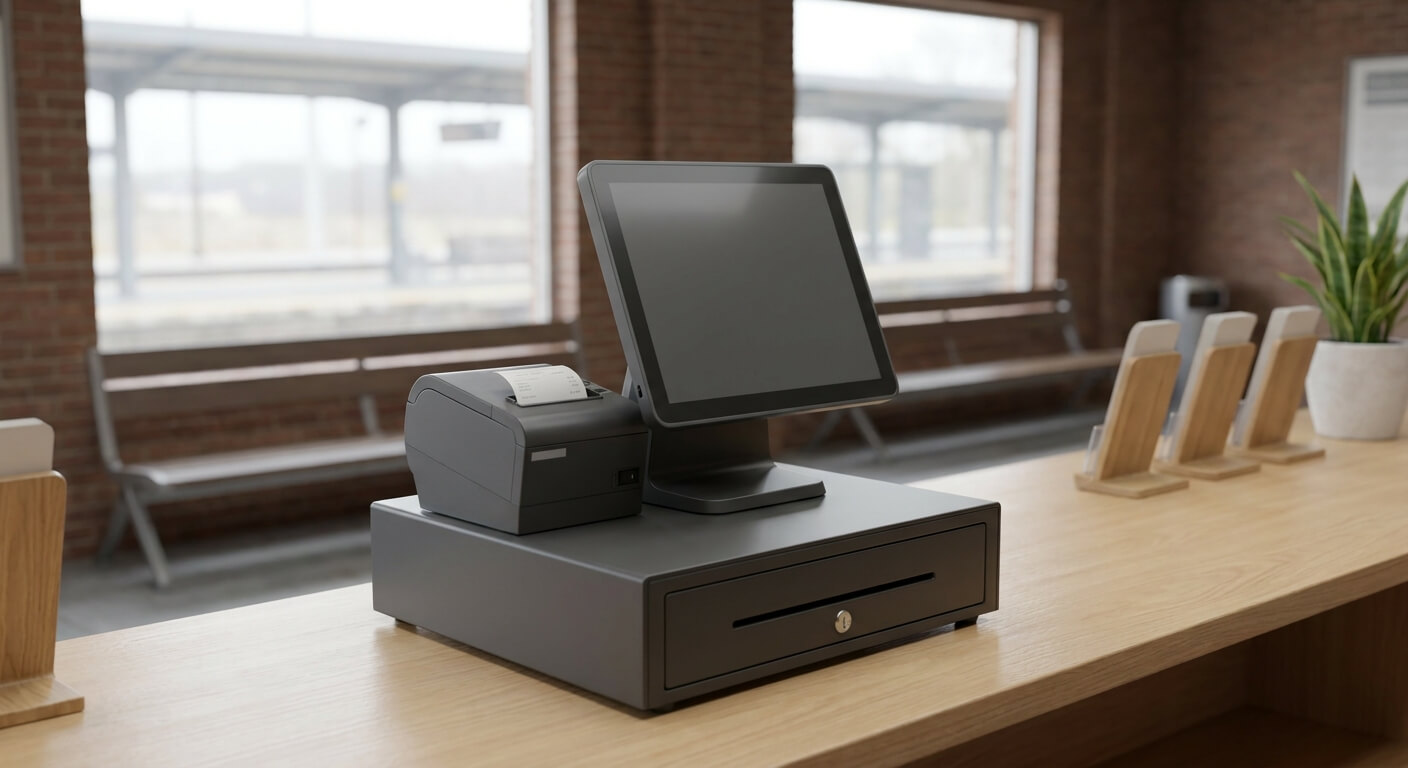
Control 4: One Drawer per Agent per Shift
When two agents share one drawer in bus ticket cash handling, a difference at closing belongs to nobody. Give each agent a separate drawer, or a separate login on the system, for the length of the shift.
If you cannot do that at a busy window, record the hand-over with a count at the moment of change.
This is also a simple way to be fair. An agent who is accurate gets a clean close every day, and an agent who needs more training becomes visible early, before small habits turn into large gaps.
Control 5: Count and Reconcile Every Shift
The end of the shift is where bus ticket cash handling pays off. The agent counts the drawer, subtracts the float and compares the result with the cash sales the system shows for that agent. The two numbers should match, and any difference is written down before anyone leaves.
Do not wait until the end of the week to look for gaps. A difference found the same day can be traced to a handful of sales, while one found a week later is a guess. For the full routine, see our checklist for the bus counter closing procedure.
Control 6: Review Exceptions Every Week
Most shifts of bus ticket cash handling will close clean. The ones that do not are your most useful data. Keep a short list of every difference, every manual refund and every voided ticket, and look at it once a week with your station manager.
You are looking for patterns, not for blame. Does the same window show gaps on busy mornings? Do refunds cluster around one route or one time of day? A pattern points to a process problem you can fix, such as a short queue at the window or a missing step in training.
How Reporting Supports Bus Ticket Cash Handling
Manual counting is only half the job. The other half is a report that tells you what the system believes was sold. If that report is only available after the office closes, you cannot compare it with the drawer on the spot.
UBT lists real-time reporting as part of its POS capability. When you evaluate any system, ask how quickly a cash sale shows up in the sales report, and whether you can filter it by agent and by shift. Our article on the bus daily sales report shows which columns are worth having.
Also ask what happens when the connection drops. A counter that cannot record sales during an outage will go back to paper, and paper is where cash handling controls usually fall apart.
Questions to Ask Before You Change Your Process
Before you rewrite your rules, look at what happens today. Walk through one full shift with the agent and note each point where cash changes hands without a record. Those points are the first ones to fix.
Then ask your team three plain questions. Where do they feel unprotected? Which step slows the queue? What would they stop doing if the system let them? Their answers will often be more useful than any template.
If you are comparing systems, add a short test to your trial. Sell a ticket for cash, refund it, void another, and close the shift. Check that every step appears in the report without any manual fix. Our bus ticketing trial checklist lists more tests worth running.
Final Thoughts on Bus Ticket Cash Handling
Strong bus ticket cash handling is not about distrust. It is about making every shift easy to check, so honest work is visible and mistakes are caught on the same day. Start with the float and the closing count, then add the other controls one at a time.
UBT offers its technology as a service, and its site says that if you do not like it, there is no cost and no obligation. If you want to see how a point-of-sale record could fit your counters, request a UBT demo and bring your own closing routine to review.